
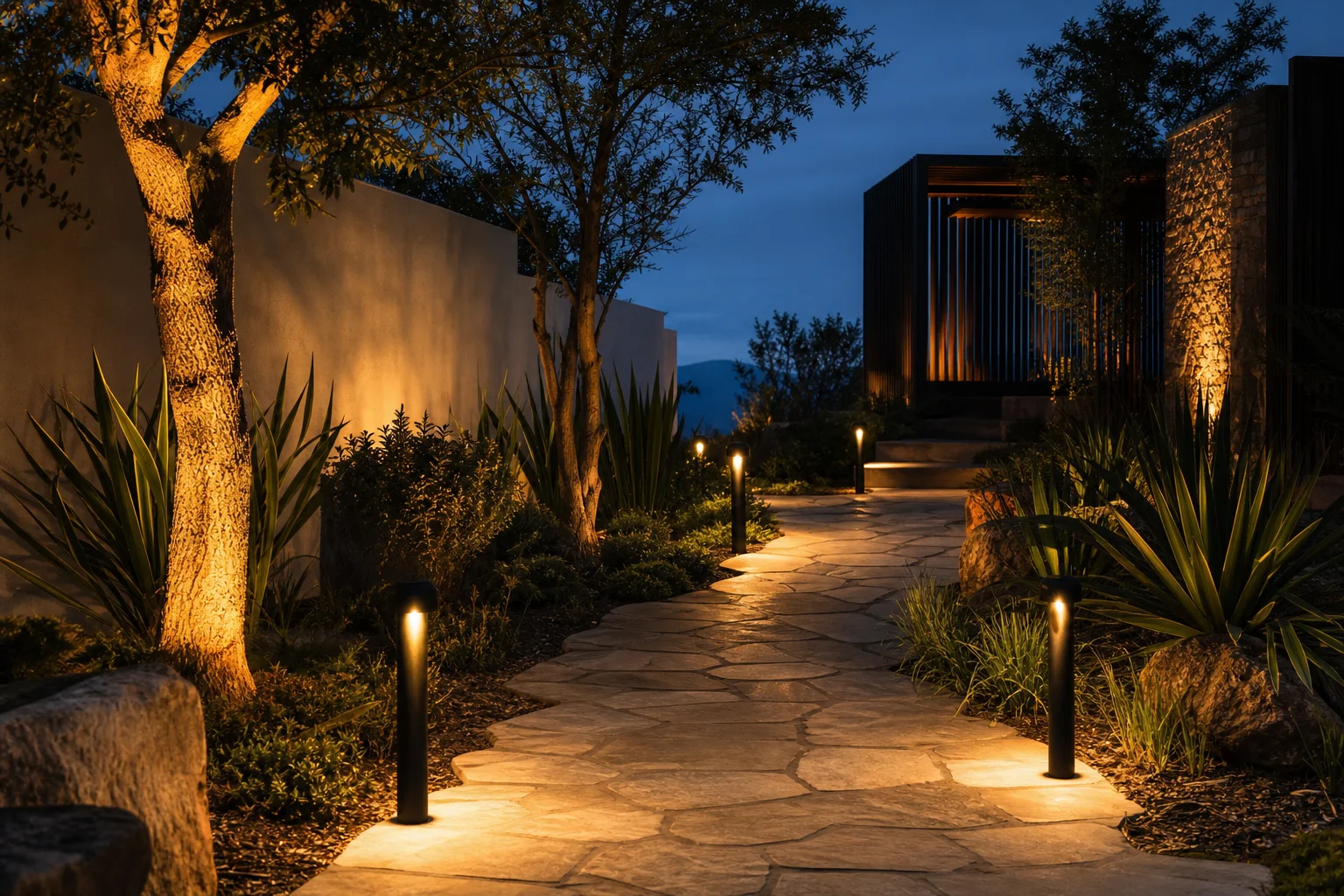
Outdoor lighting is the last layer most people get right. Gardens get flooded, pathways get over-lit, and the atmosphere that makes an outdoor space usable after dark is lost to brightness. The fix isn’t more fixtures — it’s better placement, the right IP ratings, and a layering approach that mirrors what you’d do indoors.
Layer Outdoor Lighting Like You Layer Indoors
The same three-layer principle applies outside. Ambient lighting provides overall illumination — usually soffit or ceiling-mounted fixtures under covered areas. Task lighting serves a function — pathway illumination, step lighting, security. Accent lighting creates drama — uplighting a tree, washing a textured wall, highlighting a water feature.
Most outdoor lighting failures come from using one layer only. A row of bollards lighting a pathway is task lighting with no ambient or accent. A floodlight on a wall is security lighting with no atmosphere. The best outdoor spaces use all three, dimmed and switched independently.
Placement Rules That Actually Work
- Bollards along a pathway: 3–4 metres apart. Closer than 3m and the light pools overlap into a continuous strip, which kills the rhythm. Further than 4m and you get dark gaps between fixtures.
- Step lights: mounted on the riser of each step, or on the wall adjacent to the bottom step. If mounting on the riser, centre the fixture horizontally. If on a wall, position 200–300mm from the step edge.
- Wall lights: 1.8–2m to the centre of the fixture. Below 1.8m and you risk glare at eye level. Above 2m and the light spread becomes too narrow on the wall surface below.
- Spike lights for uplighting trees: 300–500mm from the base of the trunk, angled at 30–45° upward. Closer than 300mm and you create a hot spot on the bark. Further than 500mm and the beam disperses before it reaches the canopy.
IP Ratings — A Quick Field Reference
- IP44: Suitable for covered areas — under a roof overhang, on a covered patio. Not rated for direct rain exposure.
- IP54: Exposed but sheltered — an open patio, a wall position with some wind-driven rain protection. Will handle splashing but not jetting water.
- IP65: Direct rain exposure — the standard for most outdoor wall lights, bollards, and pathway lights in South Africa. Rain, dust, and water jets from any direction.
- IP67: Submerged or ground-level — step lights set into paving, ground-recessed uplights, any fixture sitting in a drainage area where water pools.
For a deeper technical breakdown of IP ratings in coastal South African conditions, read our guide to IP Ratings for Outdoor Lighting in Coastal SA.
Common Mistakes
Over-lighting gardens is the most frequent error. Four spike lights on four trees in a small garden is already too much. Two well-placed uplights on feature trees, with low-level pathway lighting, will always look better than eight fixtures fighting each other.
Wrong beam angle on spike lights is the second. A 15° beam on a tree with a wide canopy lights the trunk and nothing else. A 60° beam on a slender tree washes the wall behind it instead of the tree. Match the beam angle to the canopy spread.
Finally — glare. An outdoor wall light that faces a neighbour’s window or a seating area at eye level is a problem. Choose fixtures with downward-only light distribution for wall-mounted positions near boundaries.
Coastal SA Material Considerations
In coastal areas, fixture material matters as much as IP rating. Marine-grade 316 stainless steel will outlast 304 by years. Powder-coated aluminium is fine if the coating is intact, but any scratch will corrode. Solid brass and copper develop a patina but won’t structurally fail. Avoid die-cast zinc fittings within 5km of the coastline — they will pit and fail within 2–3 seasons.
Written by REO