
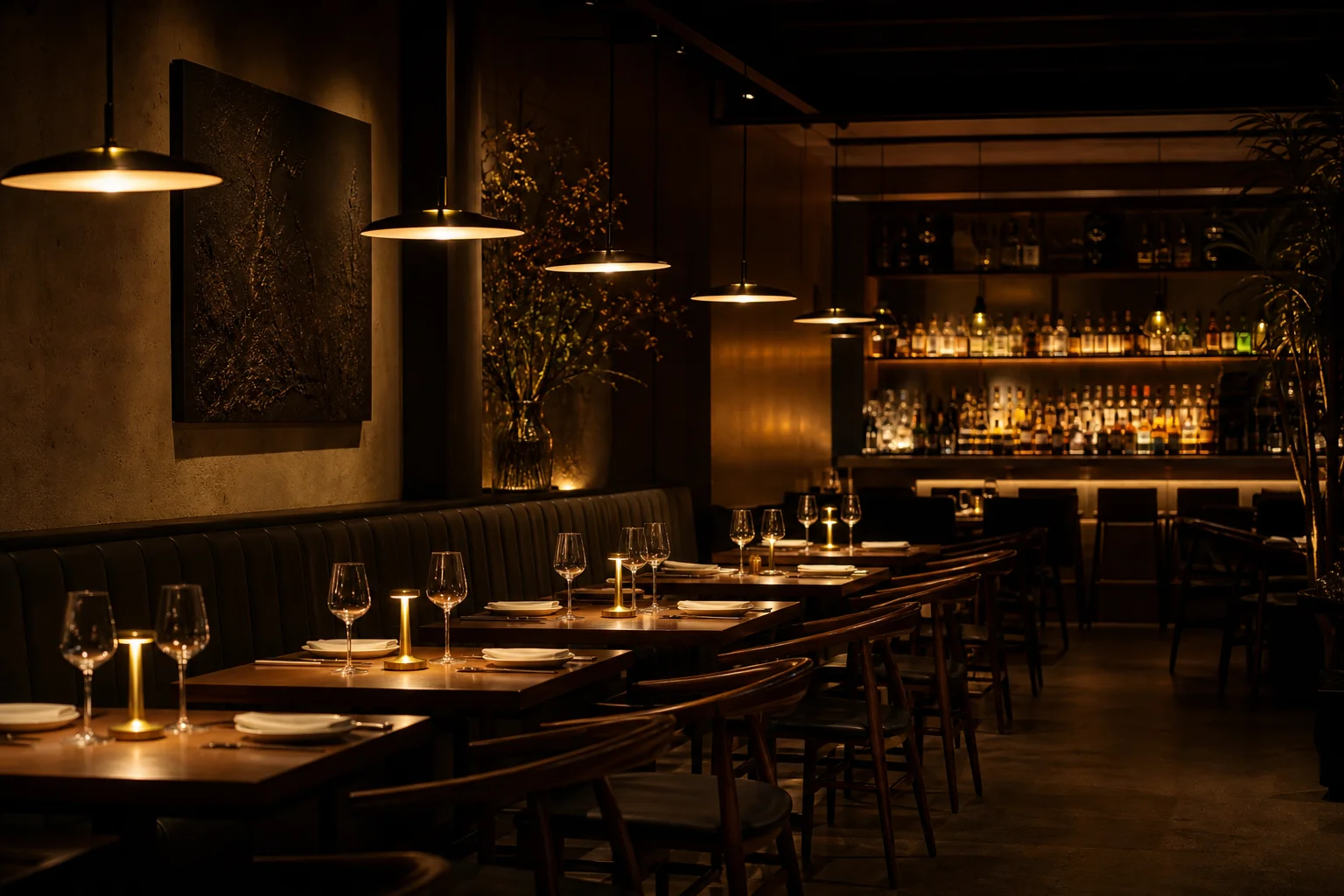
A restaurant’s lighting will do more for its success than its menu. Diners eat with their eyes first, and if the room is lit badly — too bright, too uniform, too cold — the food looks worse, the space feels cheaper, and the experience fails. Restaurant lighting is not interior design. It is commercial engineering.
The Core Principle: Uneven Light
A restaurant needs pools of light on tables, darkness between them, and deliberate contrast from one zone to the next. Uniform brightness — the same light level everywhere — makes a restaurant feel like a canteen. The eye should move around the room and find variation: a bright bar, a dim dining area, a moody entrance.
This means fewer fixtures than you’d think. A dining room with 20 tables doesn’t need 20 downlights. It needs table lighting (low pendants or wall lights at booth height), minimal ambient lighting (enough to navigate safely), and accent lighting for feature elements.
Table Lighting
The biggest mistake in restaurant lighting is downlights directly above diners’ heads. It creates downward shadows on faces, flattens the food on the plate, and makes every table look the same.
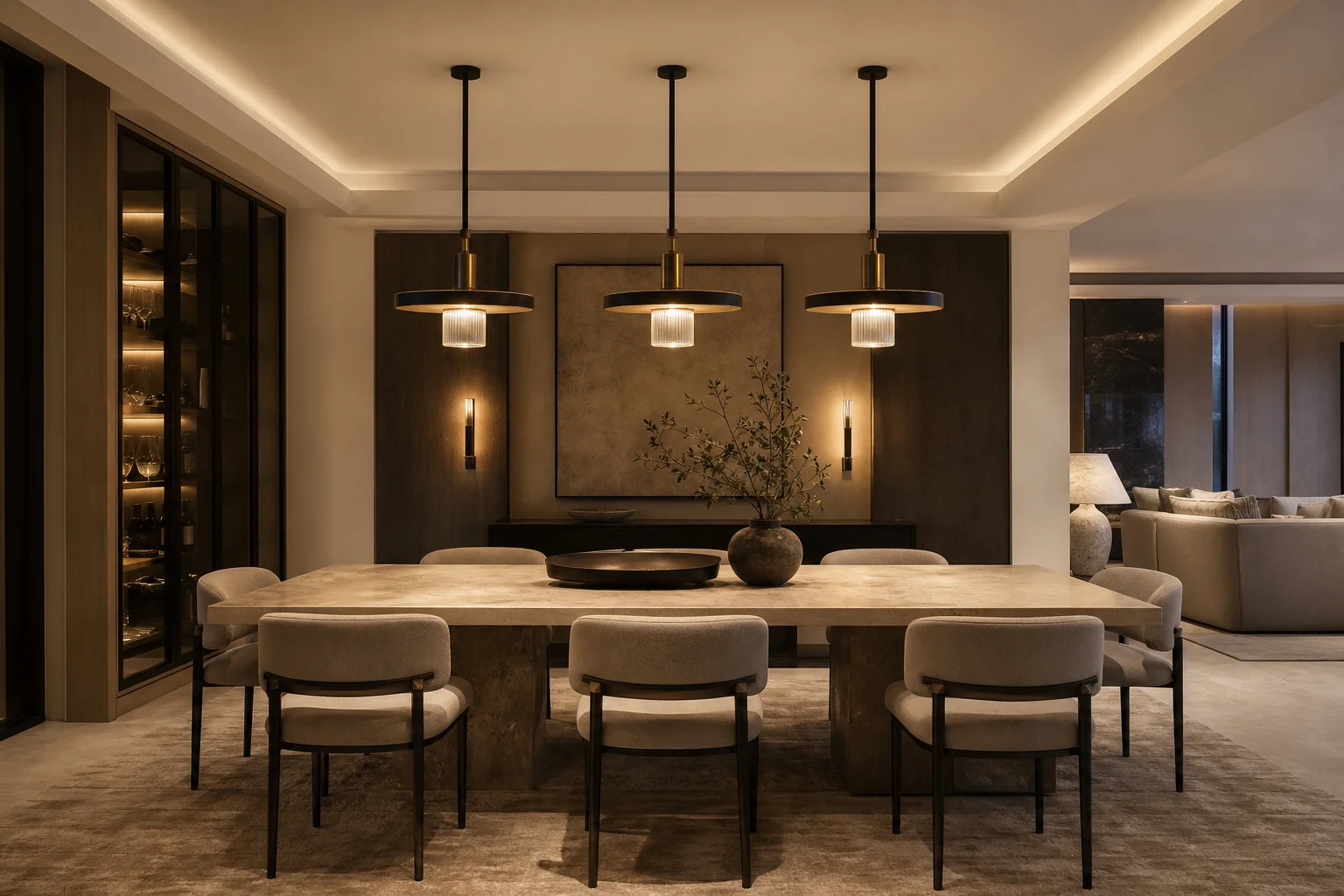
Instead: low-hung pendants at 600–700mm above the table surface, or wall lights at booth height (1.2–1.4m). The light source is close to the table, creating a pool of warm light on the surface and the food. Faces are lit from the side or at a low angle, which is flattering. The space between tables stays dim, which gives each table privacy and intimacy.
For shared tables or long banquette seating, use linear pendants or a continuous low-level wall light running the length of the banquette.
Bar Lighting
The bar should be brighter than the dining area. It’s a task zone — bartenders are working, not relaxing. Use linear pendants above the bar surface, or track spots aimed at the bar top, at a higher intensity than the dining room.
The brightness contrast between bar and dining room is the transition that signals “this is where the energy is.” A dim bar with bright dining feels backwards. A bright bar with dim dining feels right.
Entrance and Transition
The entrance is the first impression. It should be the brightest interior zone — not floodlit, but clearly more lit than the dining area. This lets diners’ eyes adjust from the street to the interior. As they move from entrance to bar to dining, the light level steps down at each transition. This is deliberate wayfinding through brightness, not signage.
If the restaurant has a dark, moody dining room, the transition from the bright entrance should feel like entering a different space. The contrast is what makes the dining room feel intimate rather than just dark.
Colour Temperature: 2700K, No Exceptions
2700K throughout. Restaurants are about food, wine, and skin. Warm light makes food look appetising, wine look rich, and skin look healthy. Cool light (3500K–4000K) makes food look pale, wine look flat, and skin look grey. If you’re tempted to specify 3000K for “a slightly cleaner look,” don’t. 2700K is the restaurant standard globally, from Cape Town to Tokyo.
CRI: 90+ Minimum
CRI 90+ is non-negotiable. The entire point of restaurant lighting is to make food look good. A CRI 80 downlight will make a beautifully plated dish look dull and desaturated. CRI 90+ renders reds, oranges, and browns accurately — the colours that make meat, pasta, and desserts look appetising.
Common Failures
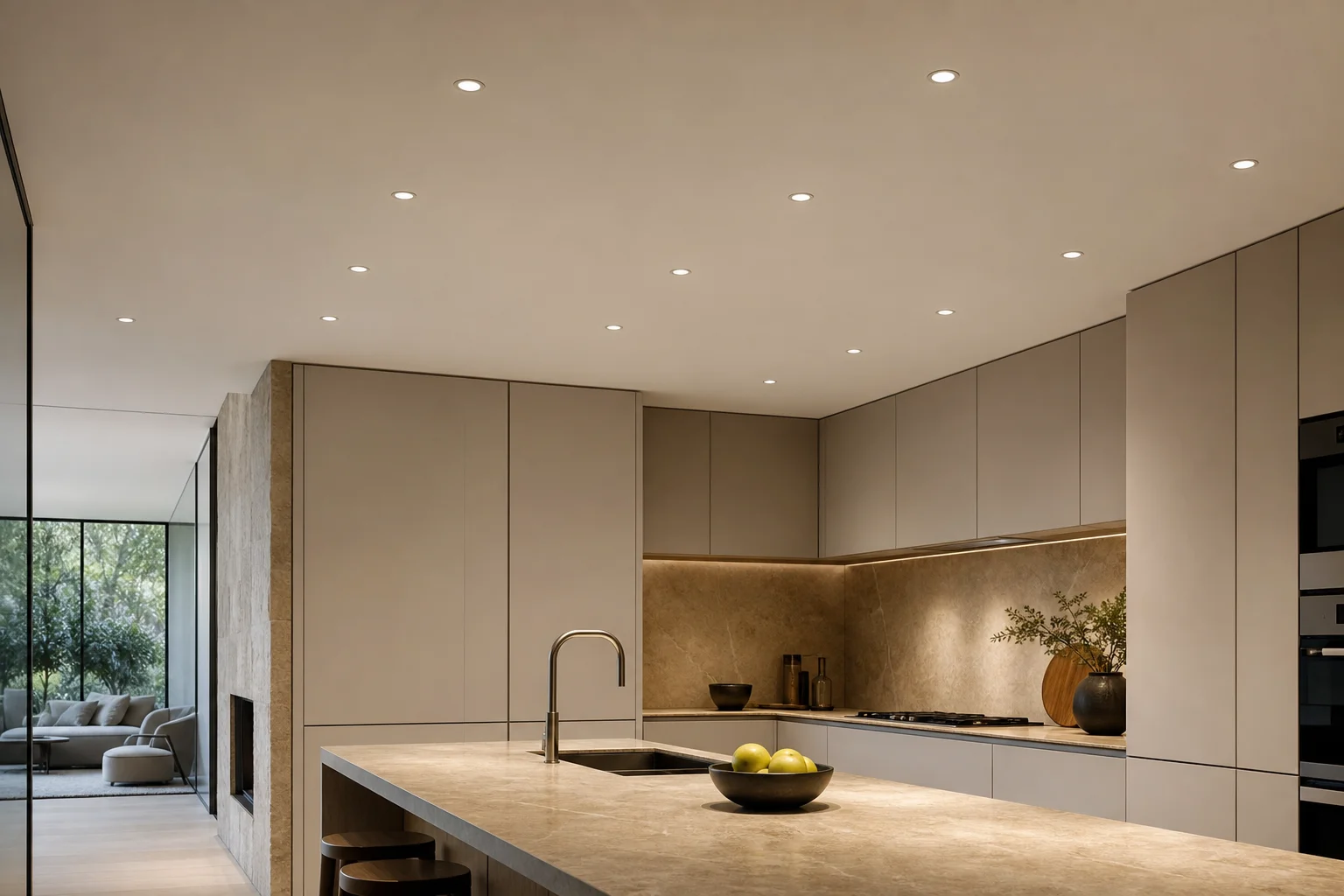
Uniform downlight grids: The most common. A ceiling full of evenly spaced downlights at the same brightness. It’s cheap, fast, and it flattens the room. Every restaurant that looks “nice but somehow forgettable” has this problem.
Dimmable but never dimmed: The dimmers are installed but the staff leave them at 100% because nobody told them the dimmer is the point. Brief the restaurant manager — the lighting should be at 60–70% for dinner service, not full brightness.
Forgetting the candle layer: Candles on tables are the final, irreplaceable layer. They provide flicker, warmth, and a focal point at each table that no fixed fixture can replicate. A restaurant without candles on the tables is missing the layer that makes it feel like a restaurant, not a meeting room.
Specification Summary
Minimum three circuits: ambient (ceiling), table (pendants or wall lights), accent (feature highlights). All on dimmers. All separately switched. 2700K. CRI 90+. And candles on every table.
Written by REO